
Babypotting is about giving babies the opportunity to pee and poop in a potty, in addition to – or instead of – using diapers. Parents learn to recognize when their baby needs to go and offer a potty when the need arises.
Seriously?
Yes! Babies are born with a sensitivity to their own elimination and have strong instincts to keep themselves, their caregivers, and their sleeping area dry and clean. They signal when they need to pee or poop, and we can learn to recognize these signals and help them relieve themselves somewhere other than on their own body – even as early as from birth. Just like we learn to interpret when a baby is hungry, cold or warm, needs closeness, or should be offered a nap to be happy and content, we can also learn when they need to go to the toilet.
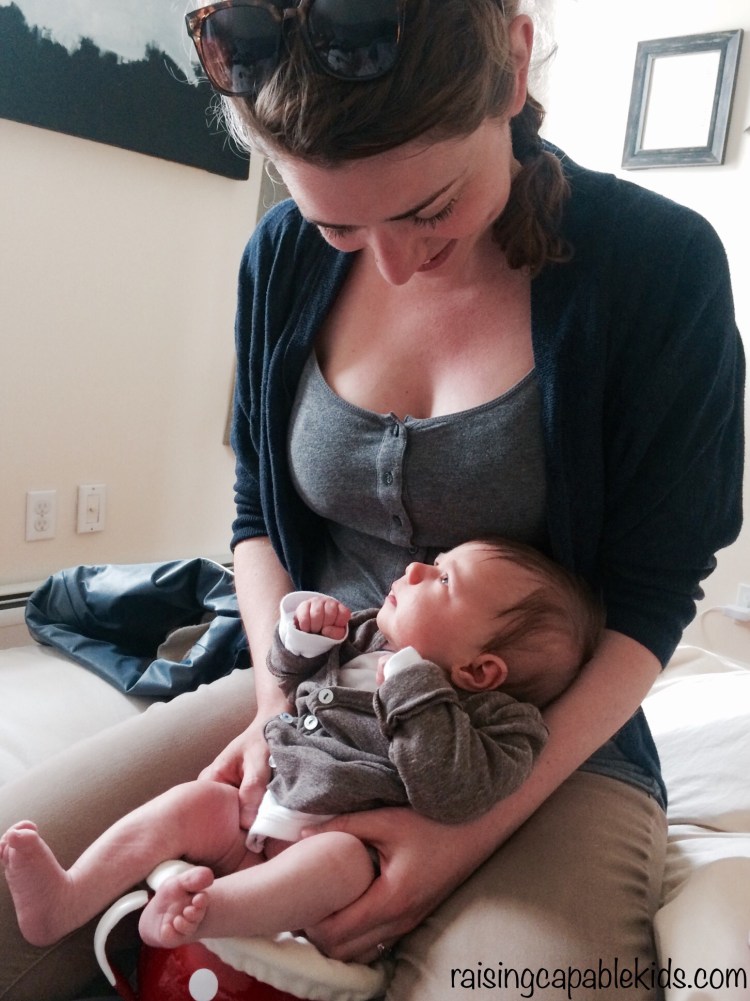
This practice is also known as baby-led potty training, Natural Infant Hygiene, and Elimination Communication (often abbreviated as EC).
That sounds really hard and demanding!
Like many new things, baby pottying can seem difficult at first. But most people find that it’s both easy and fun once they get started. Babypotting is also very flexible and can be practiced in whatever way suits you and your family best. Many opt for a “part-time” approach, focusing for example on offering the potty only during diaper changes, or after naps and meals. Most people still use diapers even while practicing babypotting. You don’t have to say goodbye to diapers entirely to succeed – you simply stop using the diaper as a toilet and start using it as a backup tool instead.
Okay, but why?
Many newborns struggle with gas, which can cause discomfort and lots of crying. By pottying your infant, you can help them release both gas (and poop), which in turn leads to a more content and happy baby. While newborn poop isn’t the worst thing in the world, it is nice to avoid changing poopy diapers – and this only becomes more appealing once your baby starts eating solids and their poop becomes more in both quantity and smell!
Many are also motivated by the environmental benefits of reducing disposable diaper use and laundering cloth diapers. Plus, you save money – also a nice bonus. Babies who are pottied early often become fully diaper-free much sooner – typically between 12 and 18 months of age. But for me, the most important reason has been the connection that forms through the communication you establish with your baby.
I’m convinced! How do I get started?
You can start any time, even from birth. Try observing when your baby eliminates and whether she gives any signals beforehand. These can be things like straining, passing gas, or becoming restless. You can also note the time intervals between each potty need – this helps you learn how long she can hold it and how often to offer the potty. When you’re ready to offer it, try removing her diaper and holding her in a squatting position over the sink or toilet.
If you want a simple and practical introduction to babypotting, I’ve created a digital video course you can take anytime – on the go or while breastfeeding in bed. It’s just one hour long and gives you a thorough and efficient introduction, adapted to Norwegian conditions.
This course is unfortunately only available in Norwegian at the moment. We are working on getting it translated into English.
More about babypotting
The term Elimination Communication was first used by Ingrid Bauer in her book Diaper Free! The Gentle Wisdom of Natural Infant Hygiene. Bauer had spent time in Africa and India, where she observed mothers carrying small, diaper-free babies. When the babies became restless or otherwise signaled they needed to go, the mothers would take them out of their wraps and hold them over a potty or another suitable spot, and the babies would do their business there. She never witnessed an “accident” and became very interested in the method. So interested, in fact, that she chose not to use diapers with her own children. Later, she created an online community and wrote a book about her experience with diaper-free babies. Babypotting is becoming increasingly popular among Western parents seeking a more natural and eco-friendly alternative to full-time diaper use.
Curious about what the research says about babypotting? Here’s my favorite article: https://www.parentingscience.com/infant-toilet-training.html
 blibleiefri.no